
This post may include affiliate links. As an Amazon Associate I earn from qualifying purchases.
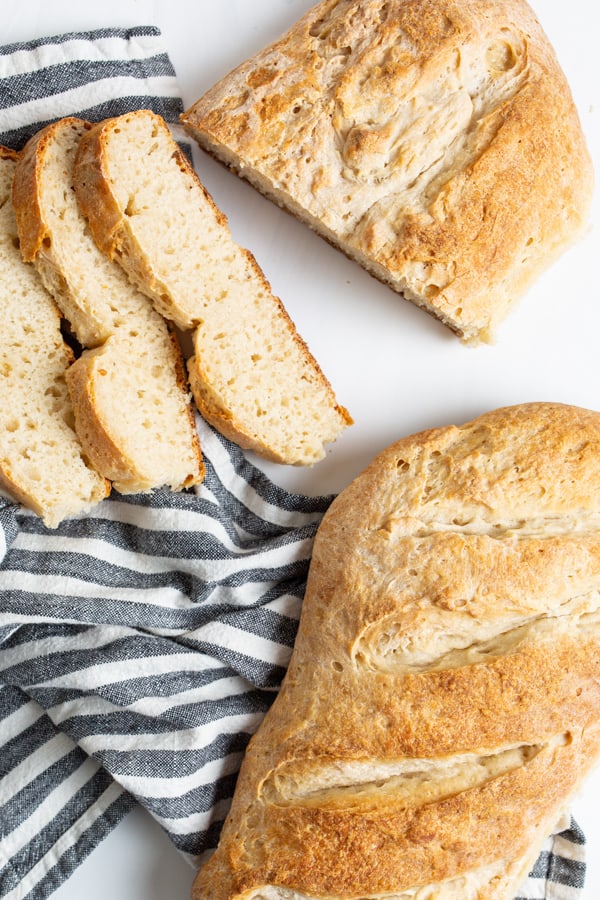
This no yeast sourdough bread recipe is extra tangy and uses just 5 ingredients! It does take a while from start to finish but it’s 100% worth it for that tangy sourdough taste. Trust me, you’ll love making this easy bread!
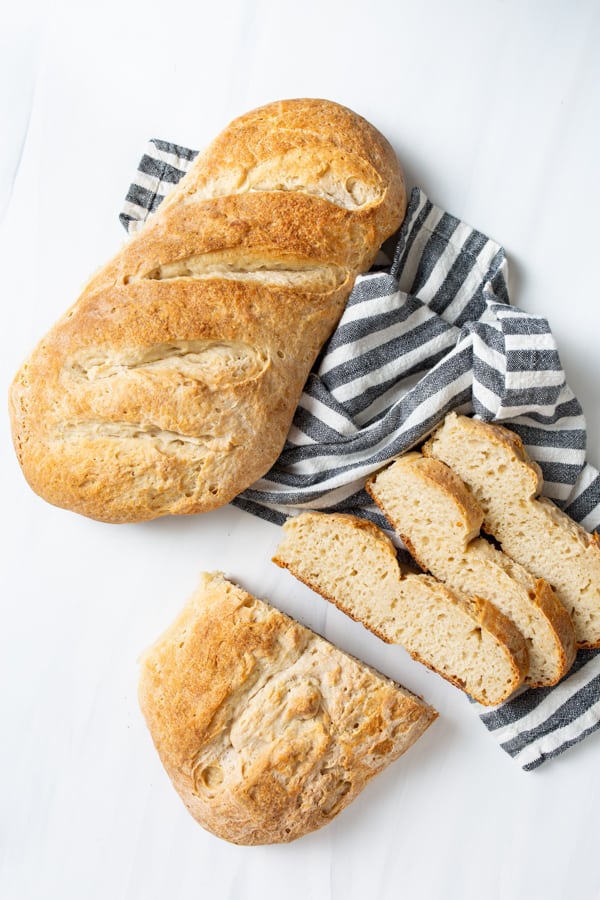
Disclosure: King Arthur Flour sent me products for no charge but all opinions are 100% my own.
There is never a bad time to make bread.
Especially if that bread is sourdough!
Even more specific – no yeast sourdough bread! Mostly because there are times when you simply cannot find yeast or you just don’t want to hit up the grocery store.
Now, because this bread uses no added yeast it takes a bit of time from start to finish.
Please don’t let that stop you from making this bread though.
It turns out super tangy and most of the work is hands-off. And by hands-off I mean you’ll basically just be waiting for it to rise after each step.
Honestly, you couldn’t ask for an easier bread recipe.
I should also note that this recipe makes 2 loaves and this freezes like a dream.
Everyone needs a loaf of sourdough in the freezer – right?
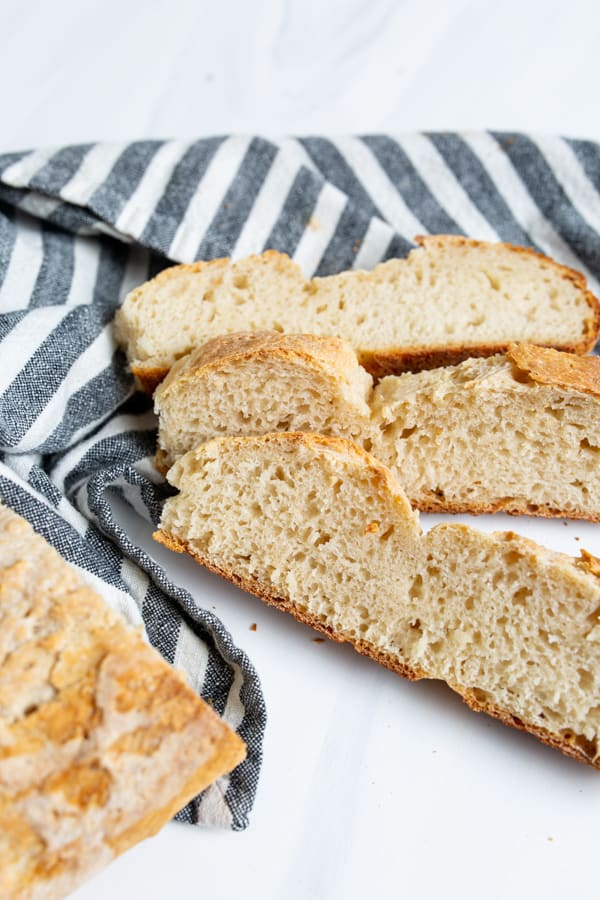
Table of Contents
How no yeast sourdough bread works
I’m not going to pretend to be a scientist so I’m going to share what King Arthur Flour says about this bread.
“What makes the sour in sourdough bread? It’s a combination of lactic and acetic acids, created as the dough rises and ferments. Refrigerating the dough encourages the production of more acetic than lactic acid, and acetic acid is much the tangier of the two. Thus, refrigerated sourdough bread before baking will have a more assertive sour flavor.”
How cool is that? I want my sourdough bread to be as TANGY as possible, and with this recipe, that is exactly what you get.
If you’re new to the world of bread making, this is a pretty easy recipe to start with. Plus, besides the waiting, it’s really easy, and you’ll be rewarded with two beautiful loaves.
So, get that whipped butter ready because you’ll want to slather it ALL OVER this delicious no-yeast sourdough bread!
Do you need yeast for sourdough bread?
Nope! If you read the paragraph before this it lets you know precisely why!
Freezing sourdough bread
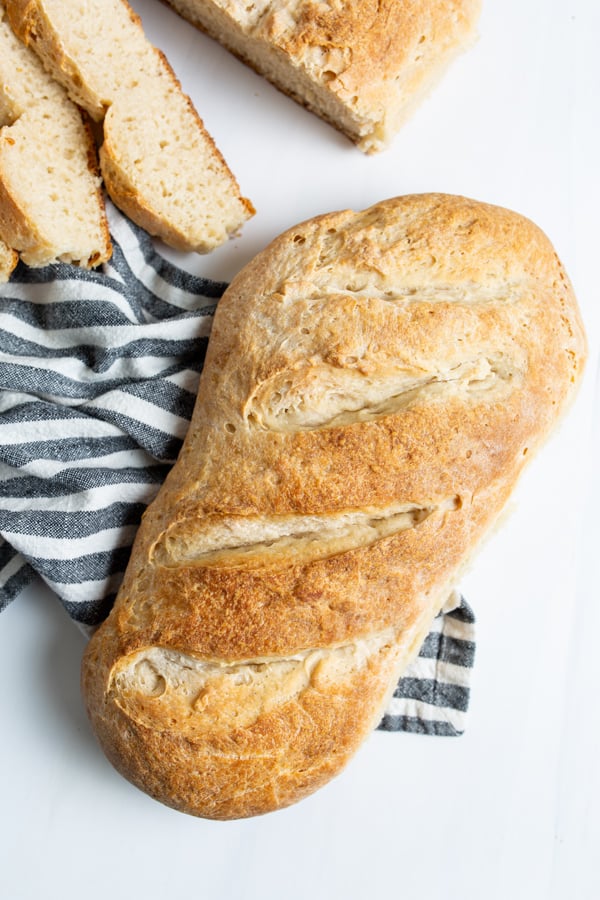
This bread freezes easily, and because it makes 2 loaves, it’s the perfect recipe for freezing.
After my loaf has cooled I wrap it in plastic wrap, place it into a large freezer-safe zip-top baggie, and store it in the freezer for up to 3 months.
You can store your bread longer BUT I think it has the flavor when eaten within 3 months.
What can I use sourdough bread for?
Besides the obvious option – eating it plain with lots of salted butter. I also like to use my sourdough bread in a few of my favorite recipes!
- Want a fun summertime salad? Try my Grilled Sourdough Panzanella Salad.
- Need a fun Thanksgiving stuffing recipe? Try my Bacon Corn Sourdough Stuffing.
- Toast it up for an easy breakfast recipe! Try my Tomato Ricotta Toast.
- Love croutons? Try my Homemade Garlic Butter Croutons.
- Craving one last fun Thanksgiving stuffing recipe? Try my Sourdough Kale Sausage Bacon Stuffing.
What is sourdough discard?
Not familiar with sourdough making? That’s ok!
When you feed your sourdough you give it fresh flour and water that gets mixed into a small portion of your starter. The remaining starter can be thrown away, given to a friend, or added to a compost pile.
It seems wasteful but that is just the life of a sourdough.
Since my sourdough sits on my counter I have to feed it 2 times a day.
I obviously don’t want to be wasteful so I started coming up with ideas on how to use my leftover discard.
How can I use my sourdough discard?
There are only so many sourdough discard recipes BUT I do have a few that will make you happy.
- First up is my sourdough discard banana bread. This bread turns out perfect every. single. time. And gives an old favorite a fun new flavor and texture. Trust me! You have to try making this bread at least once. A total banana bread crowd pleaser.
- If you’re a fan of sweets you’ll want to make my sourdough discard cinnamon crumb cake. This cake is topped with a TON of crumbly topping and doesn’t last more than 2 days in my house. I eat it for breakfast, dessert, and a midnight snack. It’s so dang good.
- Lastly, if you’re looking for a fun sweet breakfast bread you need to try my cinnamon raisin sourdough bread. Not only is the swirl super pretty this bread is so delicious toasted and slathered with whipped butter.
FAQ for this no yeast sourdough bread recipe
Add 1/2 teaspoon sour salt/citric acid to the bread along with the kosher salt. This will give you an even tangier bread.
Yes! I wrap my cooked sourdough in plastic wrap and then store it in a freezer-safe bag. I typically keep my frozen bread in the freezer for up to 3 months for optimal taste.
I take it out of the freezer and let it defrost on the countertop.
You want a nice strong starter to successfully pull off this recipe. At a minimum, you’ll want to have fed your starter for at least a week but I like to let mine go about a month before I start cooking with it. If you have a starter you have fed regularly for a year or more you do not likely have to wait this time. This is for unfed or brand new
It is recommended but I have made this with bleached flour and it turned out well.
More bread recipes
- Need a fun breakfast way to use your sourdough discard? Make my Cinnamon Raisin Sourdough Bread.
- Want a festive fall way to make bread? Try my Pumpkin Yeast Bread.
- How about a delicious and easy bread recipe? Cranberry Rosemary Focaccia.
- Short on time? Try my Sourdough Discard Banana Bread.
No Yeast Sourdough Bread

Ingredients
- 1 cup "fed" sourdough started, 227 grams
- 1-1/2 cups lukewarm water, 340 grams
- 5 cups all-purpose flour, divided, 602 grams
- 1 tablespoon granulated sugar
- 2-1/4 teaspoons kosher salt
Instructions
- In a large bowl combine the starter, water, and 3 cups of flour. Beat vigorously for 1 minute.
- Cover, and let rest at room temperature for 4 hours.
- Refrigerate overnight, for about 12 hours. The dough will have expanded in size and become more relaxed after its overnight rest.
- After refrigeration, add the remaining 2 cups of flour, sugar, and kosher salt.
- Knead to form a smooth dough. Knead either by hand or with a dough hook attached to a mixer. This may take some work, but the flour will be incorporated into the dough. You're looking for a smooth dough after kneading.
- Allow the dough to rise in a covered bowl until it's light and airy, with visible gas bubbles. Depending on the vigor of your starter and the temperature of your kitchen, this may take up to 5 hours (or even longer). For best results, gently deflate the dough once an hour by turning it out onto a lightly floured or lightly greased work surface; stretching and folding the edges into the center; turning it over, then returning it to the bowl. Adding these folds will help strengthen the dough’s structure, and allow you to feel how it’s progressing over time.
- Note: sourdough bread (especially sourdough without added yeast) can be finicky and may not go exactly to the written plan. Please allow yourself to go with the flow, and not treat this as an exact to-the-minute process.
- When the dough is ready, transfer the dough to a lightly floured or lightly greased work surface and gently divide the dough in half.
- Gently pat the dough to deflate it slightly and remove any large air bubbles. To make a loose round, stretch the outside edge of the dough away from itself and then fold it back toward the center, pressing it down to seal. Repeat this process five or six times, working your way around the dough until all the edges are gathered in the center. Turn the dough over so the seam is facing down, cover, and repeat with the other piece of dough. Let the dough rest, covered, for about 10 minutes.
- To shape into bâtards: Place the preshaped dough on a lightly floured surface and stretch it gently from the top and bottom, elongating it into an oval. Gently pat the dough to remove any lingering bubbles.
- Fold the top third of the dough down toward the center, as if folding a letter. Press with the heel of your hand to seal. Then fold the left and right top corners toward the center at 45 degree angles, pressing to seal. Repeat this process a second time. Then fold the dough in half, bringing the top edge to meet the bottom. Seal the seam with the heel of your hand, pressing firmly where the two edges meet.
- Turn the dough over so the seam is facing down. With cupped hands, gently roll the dough back and forth; your fingertips should be lightly touching its surface as you roll. Move your hands from the center out toward the edges, rounding the dough and tapering the ends very slightly by using more pressure.
- Place the bâtards on a lightly greased or parchment-lined baking sheet.
- Cover and let rise until very puffy, about 2 to 4 hours (or longer; give them sufficient time to become noticeably puffy). Don't worry if the loaves spread more than they rise; they'll pick up once they hit the oven's heat.
- Towards the end of the rising time, preheat the oven to 425 degrees F.
- Spray the loaves with lukewarm water. This will help them rise in the oven by keeping their crust soft and pliable initially.
- Bake the bread for 25 to 30 minutes, until it’s a very deep golden brown.
- Remove it from the oven, and cool on a rack.
- Store bread, loosely wrapped in plastic, for several days at room temperature or freeze for longer storage.
Notes
Nutrition
Nutrition information is automatically calculated, so should only be used as an approximation.


I have used this recipe many times and it’s the best and easy. I do use a dutch oven for 20 minutes with top on and then 15 minutes or so till the internal temperature reaches between 200 and 210 degrees fahrenheit. I also have added both roasted garlic and olives with the second flour addition (2 cups). Works every time.
You know what would be really great? If people wouldn’t comment that they follow on teitter, instagram, blh blah, or people who haven’t tried it but feel compelled to say it sounds interesting. Really, who cares? You are filling up c9mments that are not helpful to anybody!
What is the starter? We can’t get yeast
So…all that blogidy blog, blah, blah, blah and there’s no recipe for the actual sourdough starter? The comments appear to be more like fan mail. It appears no one has actually made this bread, and I can see why. It’s literally impossible to make sourdough bread calling for starter WITHOUT THE STARTER RECIPE. Zero stars. Not a fan. Will not return.
Hi Emma – thank you so much for your super helpful comment! I can see I caught you on a good day. The recipe is for the bread, not the starter. Or I would have named the recipe “homemade sourdough starter”. You can find sourdough starters available from King Arthur Flour or by asking your friends and family who might have some starter they can give you. You don’t simply whip up a batch of sourdough starter from scratch for 1 loaf of bread. In fact, at a minimum making your own starter takes at least a week and is a whole list of steps. It would not be feasible to teach you how to BOTH make your own starter and make bread in 1 post. Maybe after you have mastered making your own starter, you can come back and try this recipe. Thanks!
i have been making sour dough for over 20 years. i have never discarded any sour dough, flour is expensive. in the old days it was just stirred and fed as needed, as it was used most daily.
if i do not need it i freeze it in 1 cup platic bowls.
I’m not sure if I like this cooking method, as opposed to using Dutch oven. The bread is still raw in the middle while the outside has burnt.
This recipe is a joke. How are you supposed to add more dry ingredients to already formed dough? Total waste of ingredients. 0/10 do not recommend this recipe.
Hi Sally! The dough is not already formed, there is starter and water in the original mix. The reason is to allow the yeast to build up without getting weighed down by extra flour and without salt, which slows down the yeast. So we do that part the next day. Yes, it take a bit of time and elbow grease to incorporate but I promise it does. This recipe actually comes from King Arthur Flour and is well reviewed and I have personally used this recipe multiple times.
No Yeast Sourdough Bread – I don’t see where it says what to bake the bread in. Bread pan, Dutch oven, casserole, lids on or off, etc 🙁 I’m going to try it with my Dutch oven & hope all goes well (since I’m already making the recipe before I noticed)
You bake it on a parchment lined baking sheet pan. I have updated the recipe with clearer directions. Thank you for the feedback!
Great recipe. I do consistently use less than 5 cups of flour, but that just might be me. Bread always comes out great. I use the sourdough starter from my mom who passed away this past summer. I feel like she is with me in every loaf.